World A.S. Day 2024
Theme: Signs & Symptoms

World A.S Day is today.
Axial Spondyloarthritis (or Axial SpA/A.S.) is an inflammatory condition of the spine and joints. It works silently, like many inflammatory conditions, leaving people in increasing pain and exhaustion, especially if left untreated.
1 in 200 of the adult population in the UK have Axial SpA. That’s twice as many as Multiple Sclerosis and Parkinson’s disease, yet it’s something that many people have never heard of.
This year the theme of World A.S. Day is ‘Signs & Symptoms’ - and I’m here to share with you some of the red flags that you may experience with Axial SpA, as well as sharing a little bit of my journey with this condition.
The National Axial Spondyloarthritis Society (NASS) created the SPINE acronym to identify some of the typical symptoms that people first experience:
S: Symptoms starting slowly
P: Pain in the lower back
I: Improves with movement
N: Night time waking
E: Early onset (symptoms start under the age of 40)
This list is by no means exhaustive, but it gives individuals and GP’s an idea of things that may suggest Axial SpA is at play.
For me, one of my first symptoms was sciatica and sporadic lower back pain (this for me started about 13 years ago and crept in extremely slowly), but over the years it spread up my spine and into my ribs. I was diagnosed with Costochondritis a year or two before anything more serious was mentioned, and while it was a relief to find the cause of the sharp and tight pain I had in my rib cage, it didn’t seem to explain everything that was going on inside of my body. I also had the unfortunate luck of having Uveitis the year before my diagnosis, and again just before starting my biologic medication. (Luckily, I haven’t suffered with Uveitis since, and it’s great that my current biologic medication also holds inflammation of the iris at bay as well as controlling my Axial SpA.)
I used to wake up very stiff every morning and it would take me 2 or 3 hours to get moving. I had particular trouble with peripheral joints as well, and my feet always felt so tender as I stepped out of bed at the beginning of each new day. It was honestly a shit way to have to start every day, and it got to the point where I was waking up every night at 3am in severe back pain. I vividly remember having to sit against the radiator in the bedroom, trying to ease it so I could get a bit more sleep.
When my symptoms became continual and started to worsen, I went to my GP, only to be told that back pain was normal, that it was probably from the job I was doing. He told me I was far too young to have any of the other things that could be wrong happening to me and was told to come back in 6 months if nothing had changed. I went away from that appointment feeling hugely deflated and completely unheard. I struggled on for a number of months, until a couple of friends told me quite firmly that I needed to go back, because it was obvious that something was going on. And you know what? I knew that something was wrong, but after being told it was ‘normal’ I dismissed my own gut feelings about it all. The problem with being dismissed when we know something isn’t right is that it takes such a little amount of time to completely mistrust ourselves, but much longer to build that trust back up again. Honestly, it’s still something I’m working on, nearly 5 years later.
Luckily, when I returned to the doctors I saw a brand new GP. She was fresh to the job and enthusiastic. We talked about my symptoms and she said that I probably had Fibromyalgia - she empathised with how difficult that must be for me and said she’d do everything she could to find me some relief. Later on that evening, at nearly 8pm I had a phonecall from the GP surgery. It was the new doctor; she’d been doing some reading since I’d left and had come across something called Ankylosing Spondylitis (yet another name for Axial SpA), and she wondered if maybe it could explain a lot of what I’d been dealing with. She had run it by her manager who had said it was very unlikely, but gave her permission to pursue it with me. She said that there was a gene associated with the condition that I could be tested for. This eventually led to me having a full spinal MRI and receiving a diagnosis from a rheumatologist. I still remember the relief of hearing her suggestion on the phone that evening, even though it was something I’d never heard of and sounded extremely scary. There is such huge relief in realising that you were right; something really was wrong.
It is important to note here that a lot of people with Axial SpA do not have the HLA-B27 gene and for others inflammation will not show up in blood tests. This is why awareness and understanding is SO important, not just for individuals, but also for GP’s, who are the first point of contact for anyone suffering from back pain.
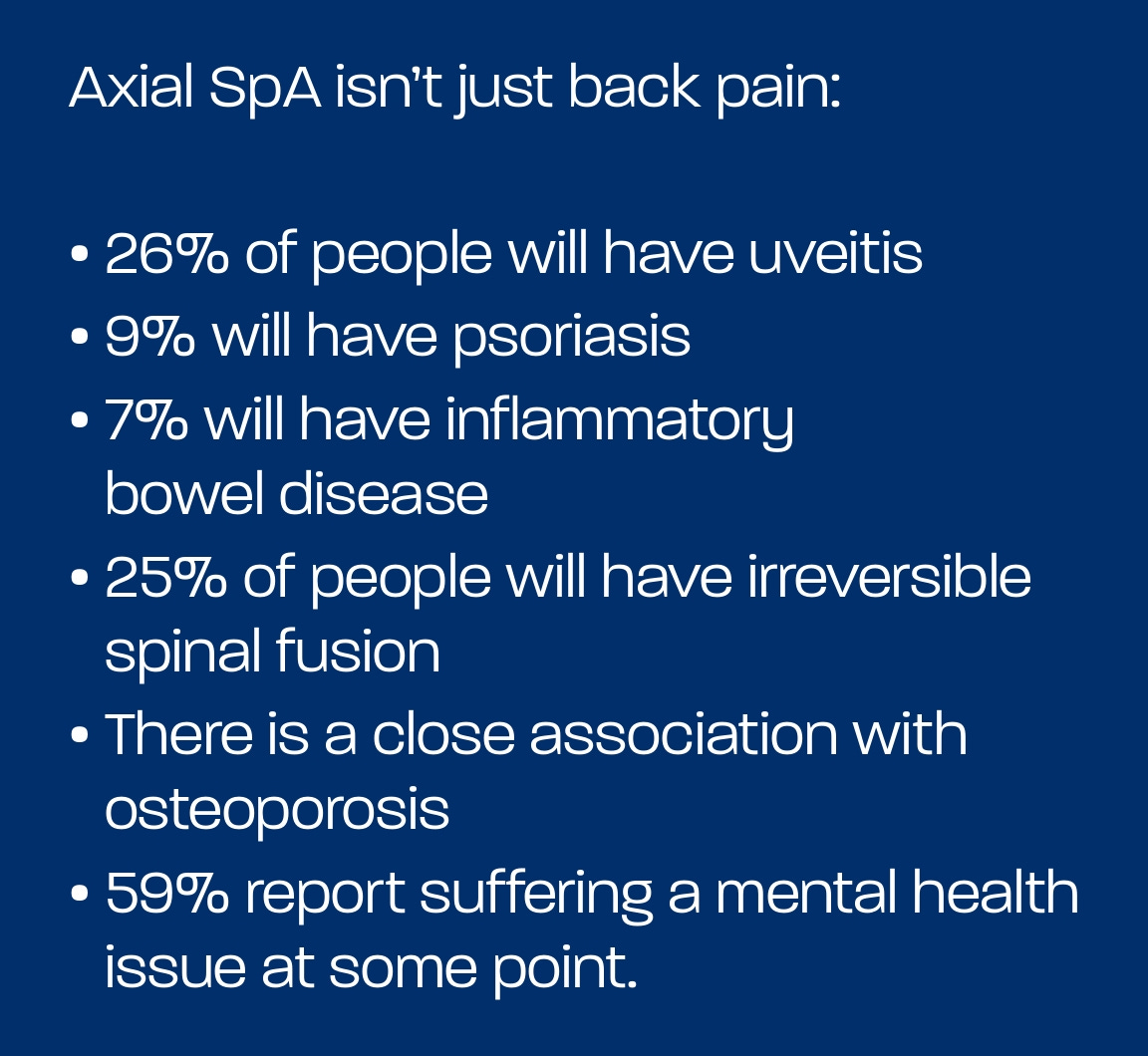
Taken from NASS website
I was excited to hear that NASS were running a Social Media Challenge this year, as I think it’s a good way for people to receive bite-sized information and real-life experiences from people who are affected by Axial SpA.
Please check out my Instagram: Uncannymoonchild to keep up to date with my #AxialSpALife posts and thank you for reading this blog today ♥
The Axial SpA community have been such an important part of my journey. Their support and reassurance have been huge in coming to terms with a lifelong condition and learning to manage it as best as I can. It’s still a journey that I’m figuring out as I go along, but I feel so much more empowered than I did when I was diagnosed back in 2020.
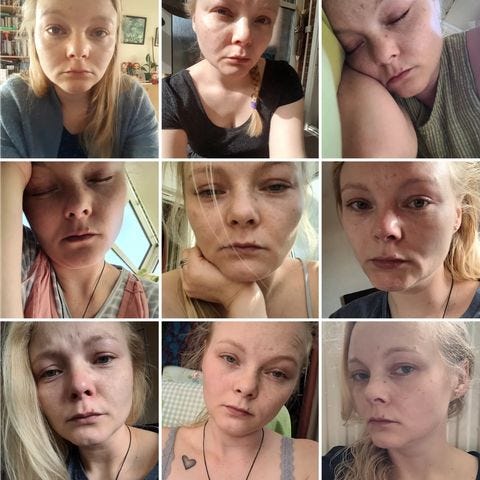
As a last note, I’m attached a post I shared back in 2022. We often don’t see the reality of chronic illness, especially on social media, but even in those we love and are closest to. Being in pain is an incredibly vulnerable place to be, and one that a lot of us try to hide. We put on a brave face because there isn’t really anything else to do, and if we don’t carry on then we’ll give up completely. I’m sharing these photos in this post as a reminder that things are not always as they seem, and to give you permission to feel and share the reality of your conditions. It does not make us weak to be vulnerable.